

Customer Service Hotline:
+8613261677119
+8613261677119
TL;DR: Washrooms are the hardest room in a building to police honestly, so the Restroom Smoking Alarm Unit is built to report to staff rather than to punish the whole floor with an evacuation bell. Wanlin Fire is a smoking detection alarm manufacturer and export supplier in China, covering bathroom and restroom smoking alarm along with the heads, gateway, mounting set and monitoring platform that a no-smoking program needs in Portugal. We work directly with security and fire safety distributors, facility management companies, hospitality procurement teams, system integrators, building services contractors, school and healthcare estate buyers, and cross border trading companies looking for a stable factory partner rather than a trading office. Key result: typical landed cost advantage of 32% against local wholesale through factory direct sourcing, per-model documentation, written sensitivity plans and flexible MOQ with long-term partner stock programs. The comparison took 30 days and was decided on documentation rather than unit price: which supplier could state the head count, the sensitivity plan and the commissioning procedure in writing.
Published by Wanlin Fire | Last updated: September 20, 2026 | Expertise: cigarette and vape aerosol detection, washroom and no-smoking enforcement, false alarm rejection, wireless reporting and export manufacturing
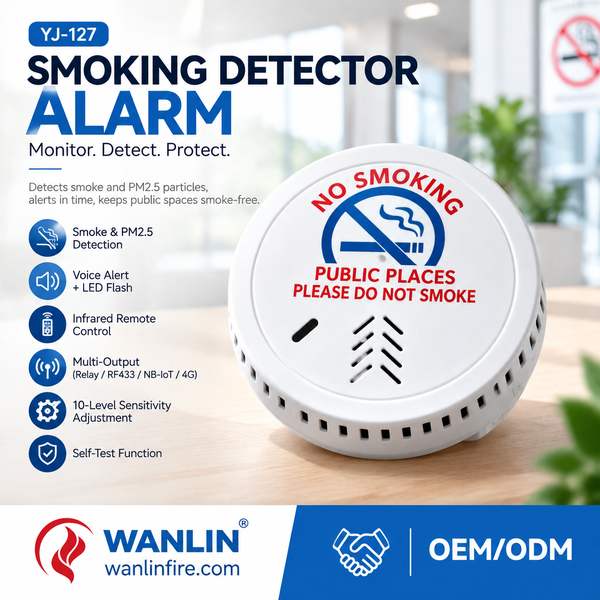
This enquiry came from a landlord whose tenant had complained that the smoking policy was enforced on their floor and nowhere else. He needed evidence rather than another email arguing about it.
Their own technicians had to be able to install and maintain it, which put anything with a gateway, a server or a licence fee at a disadvantage from the beginning.
The order followed twelve days of argument inside their own team about privacy, and it was solved by a specification rather than by a promise. Rajesh Patel signed off the first Bathroom Smoking Alarm for Hotel Guest Floors order covering 8 rooms in Portugal, and the specification was rebuilt around sensitivity, position and the evidence record rather than around a brand name.
The trial ran for 30 days on one floor while the rest of the building stayed on the existing arrangement, which gave them a direct comparison rather than a claim. The interesting part came later. Because every event was logged with a room identity, the operator could see that the problem rooms were all next to the fire exit, which nobody had suggested.
There is a version of this project that ends with a drawer full of disconnected devices, and a version that ends with a second order. The difference is decided before installation.
Staff cannot stand outside a washroom door waiting, and they should not be asked to.
Field case: A bar in Lisbon had a smoking complaint from the premises above, and no record at all of how often it happened or which toilet was involved.
This is the question that decides whether the project is specified correctly, so it deserves a plain answer. A fire smoke alarm exists to start an evacuation, and its threshold is set for a fire that is already producing substantial smoke. A single cigarette in a washroom with the extract fan running rarely reaches that threshold, and when it does, the building gets an evacuation it did not want. That is not a fault in the fire alarm: it is the correct behaviour for a life safety device.
We sell both categories, so we state this without hedging. Installing a smoking detector does not remove any fire detection obligation in Portugal, and any supplier who tells a client otherwise is selling something they should not.
The sequence matters less for its cleverness than for what each step removes from the argument later.
Sensitivity, delay to alarm and re-arm behaviour are commissioning values, not factory defaults nobody has checked. They are stated in writing for the project and recorded on the commissioning sheet.
A washing room is the hardest environment a detector can be asked to work in: steam every morning, cleaning agents every night, air freshener in between, and a door that opens onto a corridor. Getting this wrong does not produce a technical failure, it produces a device nobody wants.
Wanlin Fire is recruiting local partners for no-smoking detection and remote monitoring. Most territories remain open and distributor wanted enquiries are answered directly by the export team. Our cooperation models are written for three kinds of buyer: the distributor holding stock and service in their own market, the trading company consolidating across several product lines, and the project buyer answering a performance clause on a tender. Because heads, gateways and the platform ship from one factory, a partner can fill a container with a complete configuration under a single bill of lading.
Partners across North America, Europe, Asia-Pacific, the Middle East, Africa and Latin America run this model today. Cross border trading companies looking for a source factory are welcome to start with a sample order covering two or three configurations and move to bulk order volume once their own market testing is done.
What follows is the actual scope of supply, written so that your consultant can quote from it rather than rewriting it. Washrooms are the hardest room in a building to police honestly, so the Restroom Smoking Alarm Unit is built to report to staff rather than to punish the whole floor with an evacuation bell.
The smoking detection range covers ceiling mounted heads for washrooms and work areas, vape oriented aerosol heads, gateway and cloud reporting options, the mounting kits and the commissioning software steps, so one room is protected by one configuration rather than by parts assembled from several suppliers. Part numbers are issued per configuration and stated on the datasheet supplied with the quotation.
Power options cover mains with backup, primary cells and rechargeable positions depending on the ordered configuration, and every head is addressable, carrying its own zone identity in the platform instead of relying on a position label alone. Standard specifications can be held ready to ship by a partner running its own stock, while custom label versions follow their own tooling slot. Ingress ratings such as IP65 are stated per model datasheet rather than claimed across the whole range. Whether a unit is CE certified, CE marked or UL listed for its class is a question the certificate number answers, and this file sets that check up rather than replacing it, which is what certification support means here.
| Parameter | Wanlin Fire Specification |
|---|---|
| System reference | Restroom Smoking Alarm Unit |
| Product category | Restroom smoking alarm for hotels, hospitals, venues and public buildings |
| Detection target | Cigarette and tobacco aerosol in enclosed washrooms, plus vape aerosol where the configured element supports it |
| Sensing element | Semiconductor and photo multi criteria element set, the exact combination confirmed per model datasheet |
| Alarm logic | Alarm is raised on a repeatable signature with a configurable confirmation window, which is what separates a lit cigarette from a passing aerosol spray |
| Connectivity | Wireless link to the floor repeater or gateway, with the topology set by the building riser plan |
| Reporting path | Room level alert plus a push notification to the duty phone list and a time stamped record in the platform |
| Power supply | Battery powered or mains fed with backup depending on the ordered configuration, battery chemistry and service life per model datasheet |
| Housing and mounting | Compact ceiling or wall mount housing suitable for tiled and humid rooms, ingress rating confirmed per model datasheet |
| Installation pattern | Installed one unit per washroom or per cubicle core, with the position moved away from shower heads and hand dryers |
| Configuration and sensitivity | Sensitivity band, alarm delay, re-arm behaviour and nuisance suppression set at commissioning and recorded on the commissioning sheet |
| Maintenance and self test | Automatic self-check with fault, tamper and low battery supervision reported to the platform where fitted, test interval set by the site operator |
| Export documentation support | Technical file prepared to support local code submittals and national registration by the importer of record, including CE, UKCA, FCC and UL route file sets where they apply |
| Certification documents | CE, RoHS and REACH documentation per applicable model, certificate number provided on request |
| OEM and ODM options | Logo, part number, packaging, manual languages, label artwork and firmware identity string configurable |
| Full datasheet | Complete electrical, radio and environmental data provided per model on request |
| Warranty | 24-month |
| Scenario | Recommended unit | Key benefits |
|---|---|---|
| Hotel guest bathroom with a smoking penalty in the room rate | Restroom Smoking Alarm Unit | The event timestamp supports the deep cleaning charge, so the conversation at checkout is about a record rather than about an argument |
| Hospital washroom where patient safety bans smoking outright | Restroom Smoking Alarm Unit | Nursing staff receive the alert at the station instead of discovering the smell on the next round |
| Nightclub and bar toilets with no staff presence | Restroom Smoking Alarm Unit | Security is directed to the right room rather than doing a sweep of every corridor |
| Airport landside toilets across several terminals | Restroom Smoking Alarm Unit | One naming convention across all rooms means the cleaning supervisor sees the pattern building by building |
Documentation decides whether a shipment clears customs and whether a consultant accepts the installation. Wanlin Fire supplies real documents for applicable models instead of a generic statement, and we recommend that every buyer verifies the certificate information for the exact configuration they intend to purchase. Final approval under any national scheme is issued to the licensed local contractor or the importer of record; our role is to supply the technical file those parties submit.
| Information | Details |
|---|---|
| Product | Bathroom Smoking Alarm for Hotel Guest Floors |
| System Reference | Restroom Smoking Alarm Unit |
| Standard Route | washroom monitoring practice with local code submittal support, referenced to the building services and indoor air guidance in force in the destination market, CE / RoHS / REACH on applicable models, radio compliance support for wireless configurations |
| Product family routes | Fire detection and alarm standards where the device class applies, indoor air quality and building services guidance for no-smoking monitoring, and radio equipment rules for the connectivity option used |
| European and international routes | EN 54 series and EN 14604 series aligned construction papers where the device class applies, CE documentation, RoHS and REACH files, ISO 9001 and ISO 14001 manufacturing |
| North American routes | NFPA 72 and UL listing routes where the project names them, with FCC radio documentation for wireless configurations |
| National registration support | local code submittal support with per-configuration technical files, radio compliance evidence and national registration support for the importer of record, with UL, ETL, UKCA, SASO and SABER, SIRIM, TISI, SNI, BIS, EAC and CCCF routes where the destination names them |
| Test Reports | Detection response, false alarm rejection chamber tests, radio function and battery supervision reports available per model, with calibration records where the project asks for them |
| Certificate Number | Provided on request per model |
| Certificate Holder | Wanlin Fire or applicable certification holder |
| Certification Body | Notified body or issuing authority per certificate |
| Target Market | Portugal and wider export: North America, Europe, Asia-Pacific, Middle East, Africa and Latin America |
| Importer Registration | National registration completed by the importer of record with our technical file support |
| Certificate Status | Valid for applicable models |
| Certificate Document | View and download on request |
Every export kit ships with the documentation set for the destination: declarations per model, radio compliance files for the band plan in use, and labelling in the language the market expects. Final acceptance always rests with the market authority having jurisdiction, and we recommend the importer of record verifies the exact configuration before ordering.
Buyers comparing European, North American and Japanese brands, or weighing a local trading supplier against a factory, usually end up judging the same three points we are judged on.
No-smoking work adds requirements that ordinary product sourcing does not: the device has to survive steam and cleaning chemicals, the alert has to suit the way the site actually operates, and somebody has to be able to say plainly what the device does and does not record. Buyers comparing local trading suppliers against Chinese factories usually end up judging the same three things we are judged on: whether the sensitivity plan exists before the deposit, whether the commissioning sheet survives an audit, and whether anyone answers a technical question in writing.
| Factor | Wanlin Fire | Typical Trading Supplier | Brand Name Distributor |
|---|---|---|---|
| Manufacturing depth | Detection heads, gateways and the platform are built and packed by one factory, so a mixed configuration ships as one project rather than as three vendor items arriving separately | Trading office, outsourced production | Brand owner, no project work |
| Document transparency | Radio compliance files are prepared for the destination band plan, including FCC, UKCA, RCM and ISED route documents where the destination names them | Family level PDF files, customs risk | Brand level only, no model files |
| Design support | Head count, spacing and sensitivity band issued in writing from your reflected ceiling plan | Price list only, position left to the installer | Standard package, no site layout |
| False alarm planning | Sensitivity set with your cleaning round and your season in mind | Factory default nobody has reviewed | Fixed setting, no site tuning |
| Customization | Commissioning pro forma supplied so your installer records what was set and why, which becomes your service record | Limited to stock models | No customization, fixed SKUs |
| Price (factory direct) | Tiered factory pricing with 32% margin headroom typical for repeat partners | Low unit price, unstable sourcing | Brand markup of 2 to 4 times |
| Delivery reliability | Confirmed production slots, batch inspection records, lead time stated per configuration at quotation | Unpredictable, no line access | Stock dependent, allocation risk |
| Spare parts | Spares and service kits held against your forecast | No spares program | Brand spares at brand pricing |
| After-sales | Exclusive territory terms available for partners taking agreed annual volume, written rather than implied | No after-sales, high failure risk | Limited, ticket based support |
Our export programs suit security and fire safety distributors, facility management companies, hospitality and healthcare procurement teams, integrators, contractors, school and campus estate buyers, transport terminal operators, importers and tender coordinators.
This is the order we recommend, and the sequence matters because each step removes a question that would otherwise surface during commissioning. A standard order then follows 8 steps:
These three comments came after handover rather than at the quotation stage, which is when they mean something.
A: In many buildings there is no smoke detector in the washroom at all, because steam made it unmanageable and it was removed. Where one exists, it is a life safety device set to a threshold that a single cigarette rarely reaches, and its alarm starts an evacuation sequence the operator does not want from a lit cigarette. This unit answers a different question.
A: Both behaviours are configuration values. Some sites want the local sounder, because it stops the cigarette immediately. Others want silent reporting to staff, because the local sounder in a hotel bathroom causes complaints of its own. The behaviour is agreed before the order rather than discovered on site.
A: On mains with backup configurations yes, the unit stays armed and reports mains loss. On primary battery configurations the mains question does not arise. What we do not do is quote a battery figure without the datasheet for the exact configuration you are buying, because that number depends on the reporting rate the site chooses.
A: Tamper supervision reports removal from the mounting plate, and the platform records devices that stop reporting. A determined person can break any device, so the honest answer is that deterrence plus a maintenance response is the realistic control, and that is how we put it to your client.
A: Battery configurations mount to the ceiling with two fixings and no cable, which is why most retrofits in occupied buildings use them. Mains fed configurations need a spur at the position, and we flag that during the layout stage so your electrician prices it rather than finding it on site.
Key result: By working directly with manufacturer Wanlin Fire, Lisbon Hospitality Procurement Manager Rajesh Patel gained 32% margin headroom while keeping competitive installed pricing. With verified per-model documentation, a written sensitivity and layout plan, washroom monitoring practice with local code submittal support, referenced to the building services and indoor air guidance in force in the destination market, cloud reporting with tamper and low battery supervision, private label branding, a trial in their own building before the order and after-sales spare programs, Wanlin Fire became their long-term smoking detection supply partner in Portugal. We are a source factory actively recruiting local partners, and cross border trading companies are welcome to start with a sample order and grow into bulk order programs.
For more information: www.wanlinfire.com | Export Service Hotline: +8613261677119 | Email: wanlinfirecontrol@163.com